


Choosing between a petrol and diesel car remains one of the most practical decisions for buyers. The right choice depends on how you drive, how far you travel each year, and what you value most—upfront cost, running expenses, performance, or long-term ownership. This guide breaks down the core differences, real-world costs, and clear benefits of each option so you can decide with confidence.
How Petrol and Diesel Engines Work Differently
Petrol and diesel engines operate on distinct principles. Petrol engines mix fuel with air and use spark plugs to ignite the mixture. This design produces smoother, quieter running and allows higher engine speeds. Diesel engines compress air to a high temperature and then inject fuel, which ignites under pressure. The higher compression ratio and energy-dense diesel fuel deliver greater thermal efficiency.
Because diesel fuel contains more energy per litre than petrol, diesel engines typically achieve 15 to 30 percent better fuel economy under comparable conditions. This efficiency advantage is most noticeable on steady highway driving rather than stop-start city traffic.
Fuel Economy and Real-World Running Costs
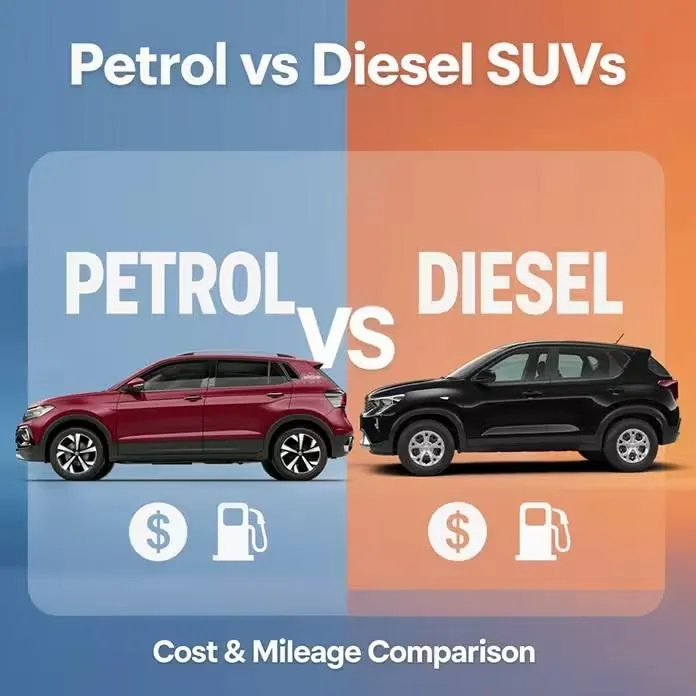
Fuel economy is the biggest practical difference. A diesel car of similar size and power usually returns higher kilometres or miles per litre. In many comparisons, a petrol model might average 30–45 mpg while the diesel equivalent reaches 45–60 mpg on mixed or motorway routes. In Indian conditions, real-world figures often show petrol mid-size SUVs at 13–15 km/l and diesels at 17–20 km/l.
Pump prices vary by country and fluctuate. In some markets diesel costs more per litre; in others it is cheaper. Even when diesel is priced higher, its superior efficiency can still produce lower cost per kilometre or mile once annual distance is high enough. For drivers covering under 15,000 km (or roughly 10,000–12,000 miles) a year, especially with mostly urban trips, petrol often works out cheaper overall. Above 20,000–25,000 km (or 15,000–20,000 miles) with significant highway use, diesel’s fuel savings usually overtake the extra costs.
Purchase Price, Maintenance, and Total Ownership Costs
New diesel cars typically carry a higher purchase price—often ₹1.5–3 lakh or £1,500–3,000 more than the equivalent petrol version—because of tougher engine construction and emissions equipment such as diesel particulate filters (DPF) and selective catalytic reduction systems that use AdBlue.
Maintenance follows a similar pattern. Petrol engines are mechanically simpler and generally cheaper to service. Routine costs for oil, filters, and minor repairs tend to be lower. Diesel engines need more robust components, larger oil capacities, and occasional attention to the DPF and injectors. A clogged DPF from too many short trips can lead to expensive cleaning or replacement. Over five years, diesel maintenance can run 15–30 percent higher.
Insurance premiums are frequently a little higher for diesels, and depreciation has been weaker for diesel models in some markets as buyer preferences shift. When all ownership costs are added—purchase premium, fuel, servicing, and residual value—petrol usually wins for low-to-medium annual mileage. Diesel becomes competitive or cheaper only when mileage is high and the car is kept for several years.
Performance, Driving Experience, and Suitability
Diesel engines produce strong torque at low revs. This makes them feel more effortless for overtaking, climbing hills, towing caravans or trailers, and carrying heavy loads. They are particularly well suited to long motorway journeys where the engine can settle into an efficient cruise.
Petrol engines revs more freely and often feel livelier in urban traffic. They warm up faster, run more quietly at idle, and handle repeated short trips without the risk of DPF clogging. For city commuting, school runs, or weekend use with limited annual distance, petrol delivers a smoother and more convenient experience.
Emissions and Environmental Considerations
Diesel cars generally emit less carbon dioxide per kilometre because they burn less fuel. However, they produce higher levels of nitrogen oxides (NOx) and particulate matter, which affect local air quality. Modern diesels use sophisticated after-treatment systems to meet strict standards, but these systems add complexity and cost. Petrol cars tend to emit more CO₂ but fewer of the pollutants most harmful in dense urban areas.
Local regulations in some cities can restrict older diesels, so buyers in those regions should check current rules before purchasing.
Longevity and Reliability
Diesel engines are built to withstand higher internal pressures and often run at lower average revs. With proper maintenance they can achieve very high mileages—sometimes well beyond 300,000 km. Petrol engines also last a long time when looked after, but the inherent robustness of diesel construction gives it an edge for high-mileage or commercial use.
Who Should Choose Petrol and Who Should Choose Diesel
Petrol is the better everyday choice for most private buyers who drive fewer than 15,000 km a year, spend most of their time in cities or on short trips, and prefer lower purchase and maintenance costs. It is also the simpler option if you want quieter running and fewer emissions-system concerns.
Diesel makes sense for drivers who regularly cover high annual distances, spend significant time on highways, need strong low-end pulling power for towing or heavy loads, or plan to keep the car for five to seven years or more. In these cases the fuel savings and durability can outweigh the higher initial and service costs.
Making the Right Decision for Your Needs
There is no universal winner. Calculate your expected annual mileage, the mix of city versus highway driving, and how long you intend to keep the vehicle. Compare specific models on real-world fuel economy, the exact price difference, and local fuel prices. Factor in any regional restrictions or residual-value trends.
In 2026 the market continues to offer both options alongside hybrids and electrics, but petrol and diesel still serve distinct practical needs. Match the engine type to your actual driving pattern rather than relying on broad assumptions, and you will end up with the more economical and enjoyable car for the years ahead.
Read more- marathimeanings.com